
The Ivies + 3: When Everyone Has to Submit Test Scores

by Valerie Erde
This is a companion to Test Optional in 2026: The Swing Back to Testing colleges-2026. Start there for the big picture.
The Fall 2025 entering class gave us something data nerds like me rarely get: a natural experiment. The Ivies + 3 (the eight Ivies plus MIT, Caltech and UChicago) are about as alike as colleges get. Similar applicants, similar selectivity, similar students. But for this one class, they split down the middle on testing:
Test-required for the Fall 2025 class: Harvard, Yale, Dartmouth, Brown, MIT and Caltech.
Still test-optional for the Fall 2025 class: Columbia, Princeton, Penn, Cornell and UChicago.
So what happened to the scores when one group had to report everyone and the other didn't?
The answer, in one chart
Why so much SAT?
At every Ivy + 3, far more enrolled students sent the SAT than the ACT. That's not a sign the colleges prefer it. The ACT is more common in the South and Midwest, and the SAT on the coasts and abroad, where much of the Ivies' class comes from. Colleges in my comparison sheets follow the same pattern: in the Northeast, about a quarter of submitted scores are ACTs; in the South and Midwest, it's closer to 40%, and as high as 70% at Tulane and Wisconsin. Take whichever test you score higher on.
Reading the results
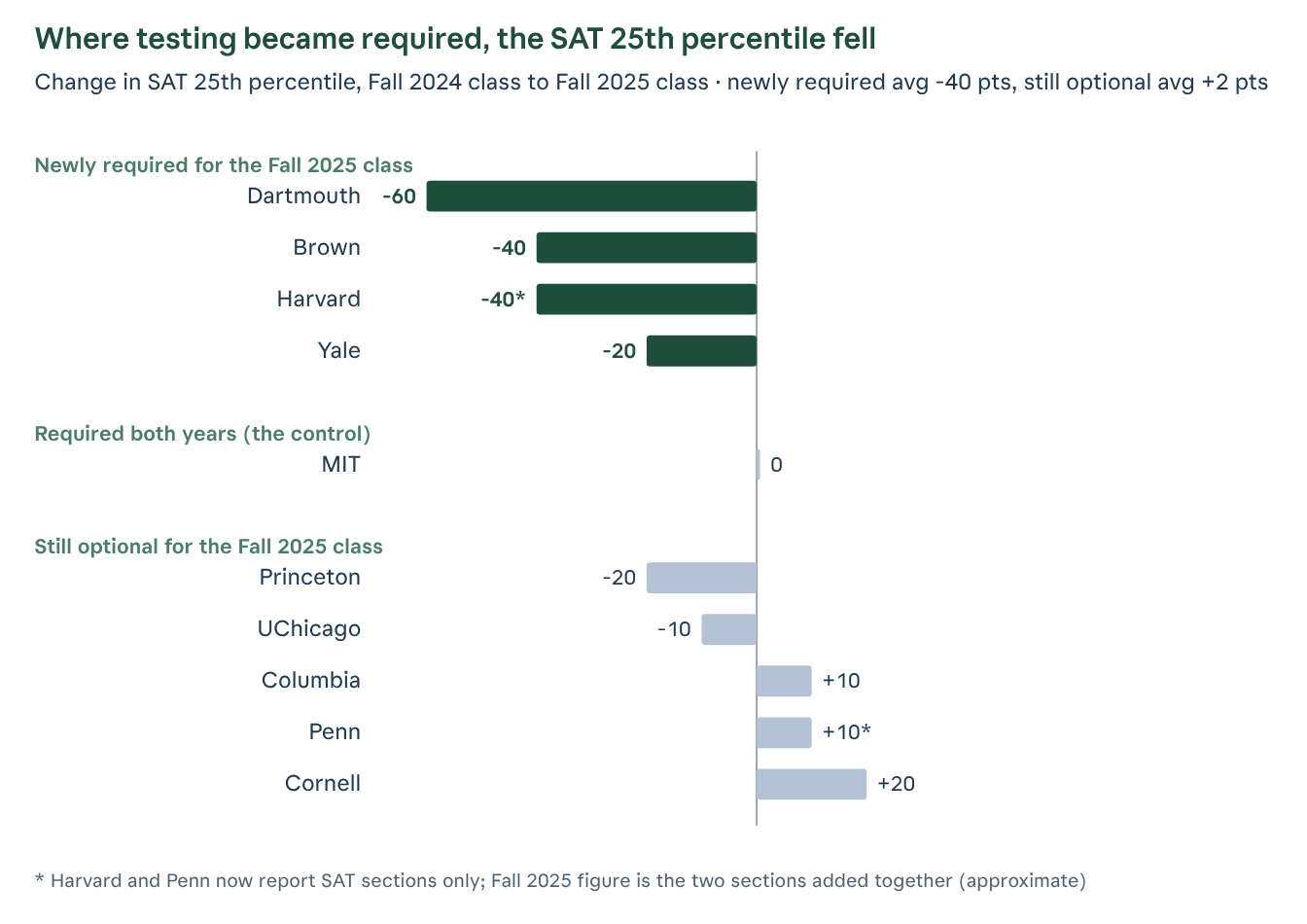
At the four schools that switched to required testing for this class, the SAT 25th percentile fell an average of 40 points. At the five schools that stayed test-optional, it barely moved: up a little at some, down a little at others, about zero on average. Year-to-year wiggles of 10 or 20 points are normal; a 60-point drop at Dartmouth is not.
MIT is the control group. MIT has required scores since the class that entered in Fall 2023, so nothing changed for it this year. Its 25th percentile: 1520, same as last year. That tells us the drop at the other schools isn't some general trend in who's applying. It happened where the policy changed.
Yale is a partial exception. Its Fall 2025 class applied under Yale's old "test-flexible" policy, which let students send AP or IB scores instead of the SAT or ACT. Students with lower SATs could still keep them out of the data, which likely explains why Yale's drop was the smallest. Yale dropped that option in May 2026, so expect its numbers to look more like Dartmouth's next year.
Caltech reinstated required testing for this class too, but I don't have a comparable figure for the year before, so it's left off the chart.
The 2025-26 numbers
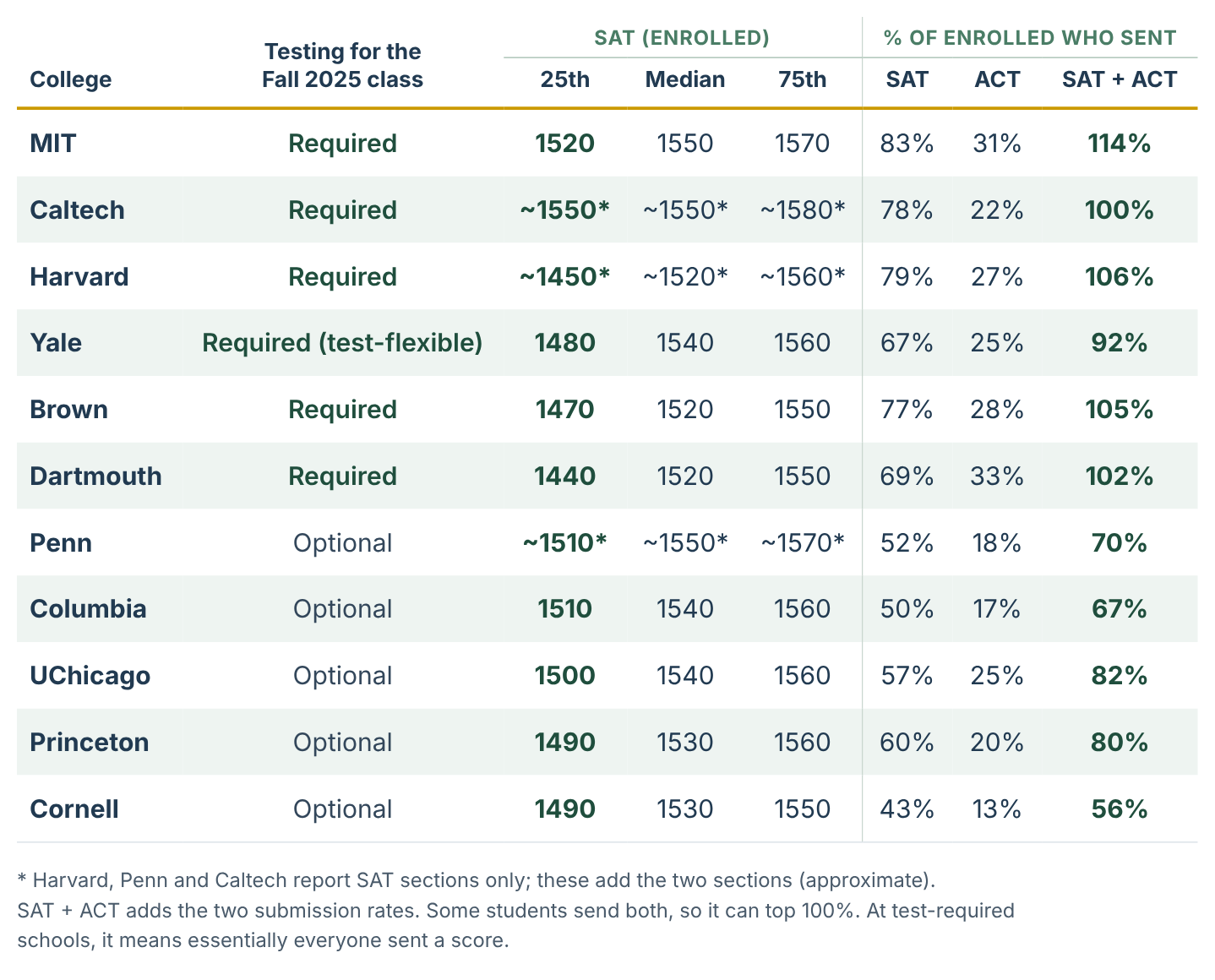
~ Harvard, Penn and Caltech now report reading and math separately; these are the two section scores added together, so treat them as approximate.
Look at the 25th percentile column: every test-optional school sits at 1490 or above, while three of the test-required schools are below 1480. That's not because Columbia is harder to get into than Harvard. It's because Columbia's lower scorers didn't have to report.
What to watch in 2026-27, and what it means for you
The experiment will get a second round. Penn and Cornell required scores for the class that entered in Fall 2026, so their next Common Data Sets will show their first test-required classes. If the pattern holds, their 25th percentiles should drop the way Dartmouth's and Brown's did. Princeton and Columbia follow for Fall 2028 entry. UChicago is staying optional, with a "no harm" policy that uses scores only if they help. I'll report back when the numbers are out.
For your student, the takeaways:
At the test-required Ivies, the published range is now real. A score around 1450-1470 is at the low end of the range at Dartmouth, Brown and Harvard, not below it.
At the test-optional ones, the range still runs high, because it only includes the students who chose to send scores. Don't rule a school out because your score sits a little under its 25th percentile.
The median is still your best benchmark, and at these schools it's 1520-1550 whichever policy they follow.
For the full picture, including research universities, liberal arts colleges and the public Ivies, read Test Optional in 2026 and download the complete 2025-26 comparison sheets.