
Test Optional in 2026: The Swing Back to Testing
by Valerie Erde
Back in 2023, I wrote that the eye-popping median SAT and ACT scores at test-optional colleges were artificially inflated: when the students with lower scores keep them to themselves, the "median" is really the median of the top slice.
Three years later, the bigger story is that the pendulum is swinging back to testing. More colleges require scores again. At many schools that are still test-optional, more of the enrolled class sent scores. And some "optional" colleges now say outright that they'd like to see them. (As for those inflated medians: the colleges that went back to requiring tests just reported their first test-required classes, and their scores came down. More on that below.)
I've updated my Common Data Set comparison sheets with the 2025-26 data (the class that started college in Fall 2025) and checked every school's testing policy for students applying now. Here's what's new, and what it means for your family.
1. More of enrolled class sent scores, even where it's optional
This one surprised me. At a lot of schools that are still test-optional, a bigger share of the students who enrolled had sent scores this year than last year.
A note on the data
Colleges don't publish how many applicants submitted scores, or admission rates for submitters versus non-submitters. The Common Data Set only tells us about the students who enrolled. So we can't tell whether more applicants are submitting, or whether students with scores are being admitted at higher rates.
Either way, the class that shows up on campus is more and more made up of score submitters.
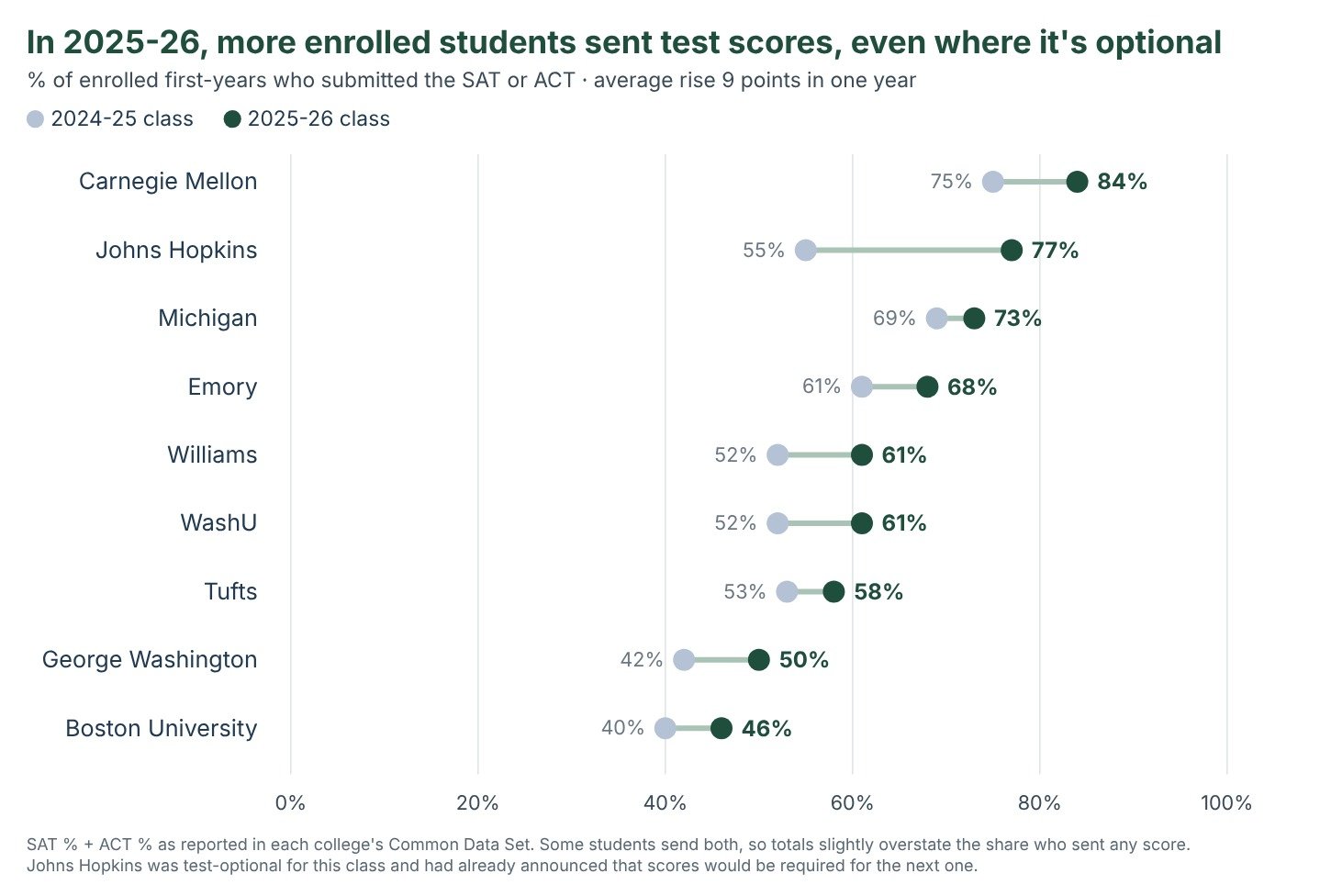
When most of the enrolled class sent scores, it's a fair bet that most of the admitted students did too, so applying without scores likely puts you in the minority. That doesn't sink an application, but it's worth knowing before you decide.
2. We called it: when everyone has to submit, test scores drop
In 2023, I explained the math this way: if the bottom 20% of applicants withhold their scores, the published median is unlikely to be the 50th percentile of the class anymore. It's probably closer to the 60th. Now look at what happened at the schools whose Fall 2025 class was the first one required to submit:
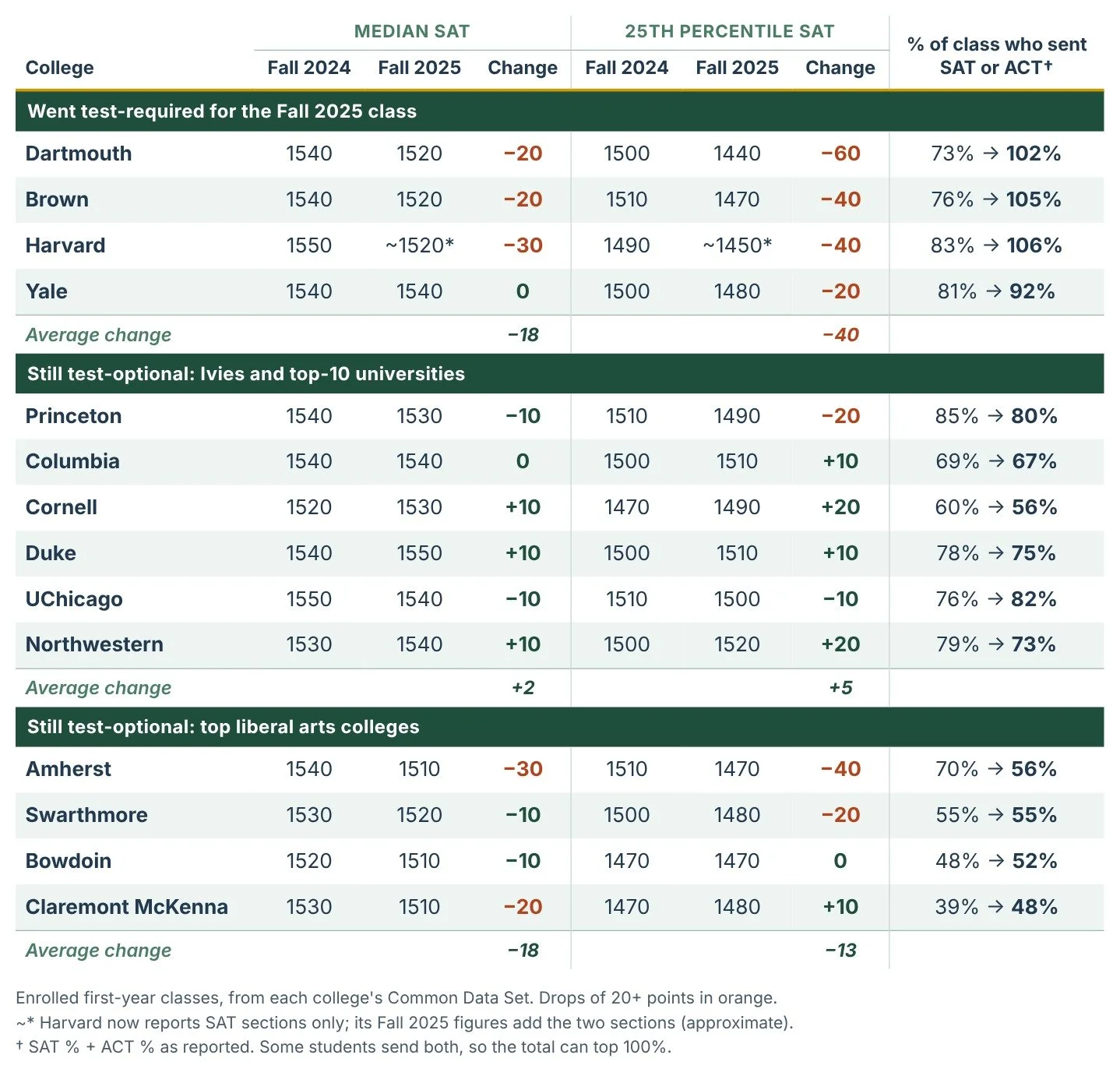
Notice where the drop is biggest: the 25th percentile, which fell 20 to 60 points. Medians moved less, 0 to 30 points. That's exactly what the math predicts, because the scores students used to withhold were the lower ones. So the median at a test-required school is still the most useful benchmark for most students. Just know that the bottom of the range is lower than test-optional numbers made it look.
These classes weren't weaker. The difference is that everyone's score is finally in the data, including the recruited athlete, the first-generation student and the student admitted for a remarkable talent whose score was just fine. At Dartmouth, a quarter of the class scored 1440 or below.
What this means for you: at test-required schools, the published ranges are now an honest picture of who gets in. At test-optional schools, they're still inflated, so don't read them the same way.
3. "Optional, but...": some colleges are telling you they prefer scores
This is the part I most want families to hear. A growing number of colleges, while officially test-optional are saying, in writing, that they'd prefer to see scores. You don't have to read between the lines anymore. Here are a few examples:
Boston College BC's own testing page says its internal research found scores add predictive value, and it encourages anyone who has tested to submit. About 66% of the Class of 2030 did.
Princeton "encourages the submission of all test scores" this year, before scores become required for the next class.
Rice officially recommends scores. It's not required, but recommended is a different word than optional.
Penn State encourages anyone who has taken the SAT or ACT to share their scores.
U. Michigan rates test scores "Important" in its Common Data Set, a notch above how most test-optional schools rate them.
Grinnell says a strong score "may help" and that without one it has less information about your academics.
On the other side, some schools really mean it when they say optional. Bowdoin, Bates, Smith, Holy Cross and Davidson have been test-optional for years (Bates since 1984), and at Bowdoin, Bates and Davidson only about a fifth to a third of enrolled students sent the SAT.
4. If you're a junior: the Fall 2028 deadline
The biggest practical change is timing. Several schools are test-optional for this year's seniors but will require scores for today's juniors (Fall 2028 entry).
Already required for this year's seniors: MIT, Harvard, Yale, Dartmouth, Brown, Cornell, Penn, Stanford, Caltech, Johns Hopkins, Georgetown, Georgia Tech, UT Austin
Required starting Fall 2028 entry (today's juniors): Princeton, Columbia, Notre Dame, Harvey Mudd, Claremont McKenna
Required starting Fall 2029 entry (today's sophomores): Vanderbilt
Under review: the UC system (faculty recommendation due by June 2027), Grinnell, Santa Clara, Wisconsin
Temporary test-optional policy ends after Fall 2027: Barnard (watch this one, since Columbia goes required)
Carnegie Mellon is its own case: Computer Science requires the SAT or ACT, most other colleges at CMU accept AP or IB scores instead, and Fine Arts is optional.
If your student is a junior with any of these schools on the list, plan to test. Full stop.
5. Smaller shifts worth knowing
"Test-flexible" is shrinking. Yale dropped it in May 2026: AP and IB scores no longer satisfy the requirement, so you need the SAT or ACT.
Some schools stopped publishing a composite SAT. Harvard, Penn and Caltech now report reading and math section scores separately, which makes school-to-school comparisons a little harder. (In my sheets, I've added the sections together and flagged those numbers.)
"Test-optional" doesn't always mean what you think. UW calls itself "technically test-optional": readers don't see scores, but high scores can rescue a few borderline applicants. UNC requires scores if your weighted GPA is below 2.8. Georgetown now lets you send a single sitting instead of every score.
The UCs are still test-blind for now, but the Regents discussed reinstating tests in September 2026, and a faculty recommendation is due by June 2027.
So should you submit? My updated advice
My 2023 advice still holds: don't decide based on the median alone. Half of all submitters are below the median by definition. Look at what share of the class submits and how your score compares with students from your own high school.
Here's what I'd add for 2026:
Take the school at its word. If a college says it encourages or recommends scores (BC, Princeton, Rice, Penn State), a solid score is worth sending.
Check the enrollee submit rate. When 55% or more of the enrolled class sent the SAT, applying without scores likely puts you at a disadvantage.
Read the ranges correctly. At test-required schools, the 25th-75th range is now more honest, so a score near the 25th percentile is truly in range. At test-optional schools, the range is still inflated.
Juniors: plan to test, period. Too many schools on a typical list now require scores for Fall 2028, and "optional" is trending toward "preferred."
Grade inflation hasn't gone anywhere either. In 2023 I noted that nearly every student I was tutoring had an A- to A average. When transcripts look alike, a strong score is one of the few ways to stand out. And a motivated student with the right materials can raise a score meaningfully in 4 to 8 weeks.
The data
You can upload my Common Data Set comparisons for 2025-26: Ivies + 3, other selective research universities, selective liberal arts colleges, and the original and new "Public Ivies." Each sheet shows the SAT and ACT ranges for enrolled students, what share of the class submitted scores, and each school's testing policy for students applying now. I've made two versions: one sorted by median SAT and one sorted by how many students submitted scores.
Want help figuring out whether to submit, or where testing fits in your student's plan? Get in touch.