
A's in Middle School Math? Why Are We Worried?
by Valerie Erde and Vickie Barone
COVID’s Effect on your child’s math foundation
— and why their grades may not reflect that yet
Vickie and I want to talk to you about a pattern we’ve been seeing, because we think a lot of families don’t realize it’s coming until it arrives.
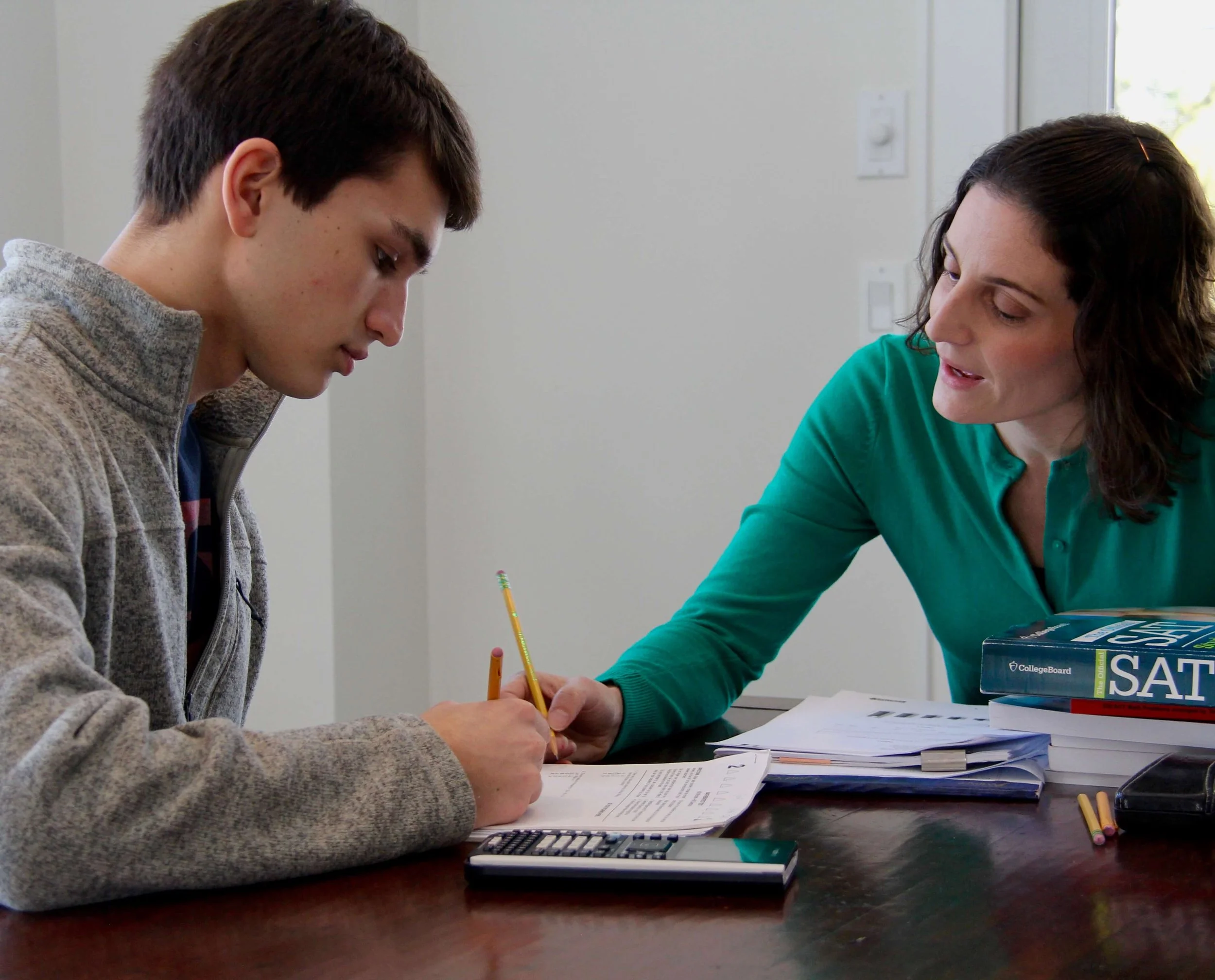
A high school rising junior — let’s call her Maya — meets with my math partner, Vickie, for the first time. Maya is a good student — she has been a good student her whole life. Solid grades all through middle school math. Even finished Algebra 1 with an A-. Currently in Geometry, she’s doing fine. Nothing on her transcript would make you look twice.
But when Maya begins working on the SAT Math section, we notice something interesting.
Maya can set up and solve a linear equation. She has learned the steps, and she follows them correctly. But when Vickie backs up and asks her to work with fractions — to compare them, combine them, reason about them without a calculator — something shifts. The fluency isn’t there. The math intuition that should have been built in 4th and 5th grade, the sense of what fractions actually mean and how they behave, is shaky in a way that the last four years of math class never required her to notice.
Maya isn’t struggling because she’s bad at math. She’s struggling because she has a gap that her grades never revealed. And that gap — as Vickie and I have come to understand it — has a very specific origin. Maya was in 4th grade during COVID.
I’ll get to the reading and writing side of this story in a separate post. But I want to start with math, because math is the more urgent conversation. Math is unforgiving in a way that English is not. Each concept is built on the last one. You can’t get through high school math and succeed on ACT and SAT math without being confronted with a gap like the one we found with Maya. And right now, a lot of freshmen and sophomores are carrying math gaps they don’t even know they have.
The A’s Are Real. So Is the Math Gap.
One thing that is important to note: the grades are not fake. Maya earned her A- in Algebra 1. She is not a student who doesn’t work hard or doesn’t try. Maya’s grades reflect real effort and real success with the material she was taught and tested on.
The problem is that high school math courses are designed to move forward. They assume the foundation is solid and build on top of it. (The same holds true about grammar rules.) A student with a gap in fraction fluency who enters Algebra 1 gets taught to solve equations — the teacher assumes fractions are handled. The gap doesn’t get addressed; it gets worked around. By the time a student reaches Geometry or Algebra 2, she has developed sophisticated enough workarounds that the grades continue to look fine, even if the foundation is shaky.
But the ACT and SAT don’t accept Math workarounds
They ask complex, layered questions — the kind that require actual number sense and combining multiple concepts in order to find solutions. Procedural memory is just not enough. And that is where the gap surfaces, often for the first time, in a way that surprises everyone.
This isn’t speculation. The ACT’s own research arm tracked more than four million students from 2010 to 2022 and found that average math GPAs rose by nearly a third of a grade point while ACT math scores fell. The grades went up. The actual math readiness went down. Those two things can coexist because grades measure performance on the curriculum as taught, and the curriculum as taught in high school does not go back and test 4th-grade foundations.
Here’s Where COVID Comes In — and This Gets Specific
I want to introduce you to research that we think every parent of a current freshman or sophomore should be aware of.
In December 2025, researchers Lauren Bauer and Eileen Powell published an analysis through the Brookings Institution and the Hamilton Project titled “Learning Curves: Post-COVID Learning Trajectories Differ by the Grade a Student Was in When the Pandemic Hit.” It followed student cohorts across 28 states through 2025, tracking proficiency in math and English from 3rd through 8th grade.
What they found was counterintuitive — and for parents of current high schoolers, it matters a great deal.
The conventional assumption was that older students would weather remote learning better. A 5th grader could navigate Zoom, watch a Khan Academy video, and reinforce learning with online practice problems. A kindergartener could not. So you might expect younger kids to have suffered more.
Surprisingly, the opposite turned out to be true.
What Bauer and Powell Research Revealed
What Bauer and Powell found:
The older the student was during the 2019–20 school year, the lower their subsequent math proficiency trajectory — and the less they recovered. By 2025, the youngest students (those in preschool through 2nd grade during COVID) were largely back to pre-pandemic levels. Students who were in 3rd grade showed initial drops but mostly rebounded by 8th grade. Students who were in 4th grade and above showed persistent deficits that never fully closed.
Why? Older elementary students were at a more complex, less forgiving point in the math sequence. Remote learning could deliver some things reasonably well. It could not deliver the hands-on, teacher-guided, immediate-feedback instruction that 4th and 5th graders need to truly internalize fractions, long division, and proportional reasoning.
The younger kids had time to recover those skills in person. The older ones missed out.
What grade was your child in During covid? That matters.
Here’s the practical translation for families with students in 8th through 11th grade right now. Find your child’s current grade in the table below:
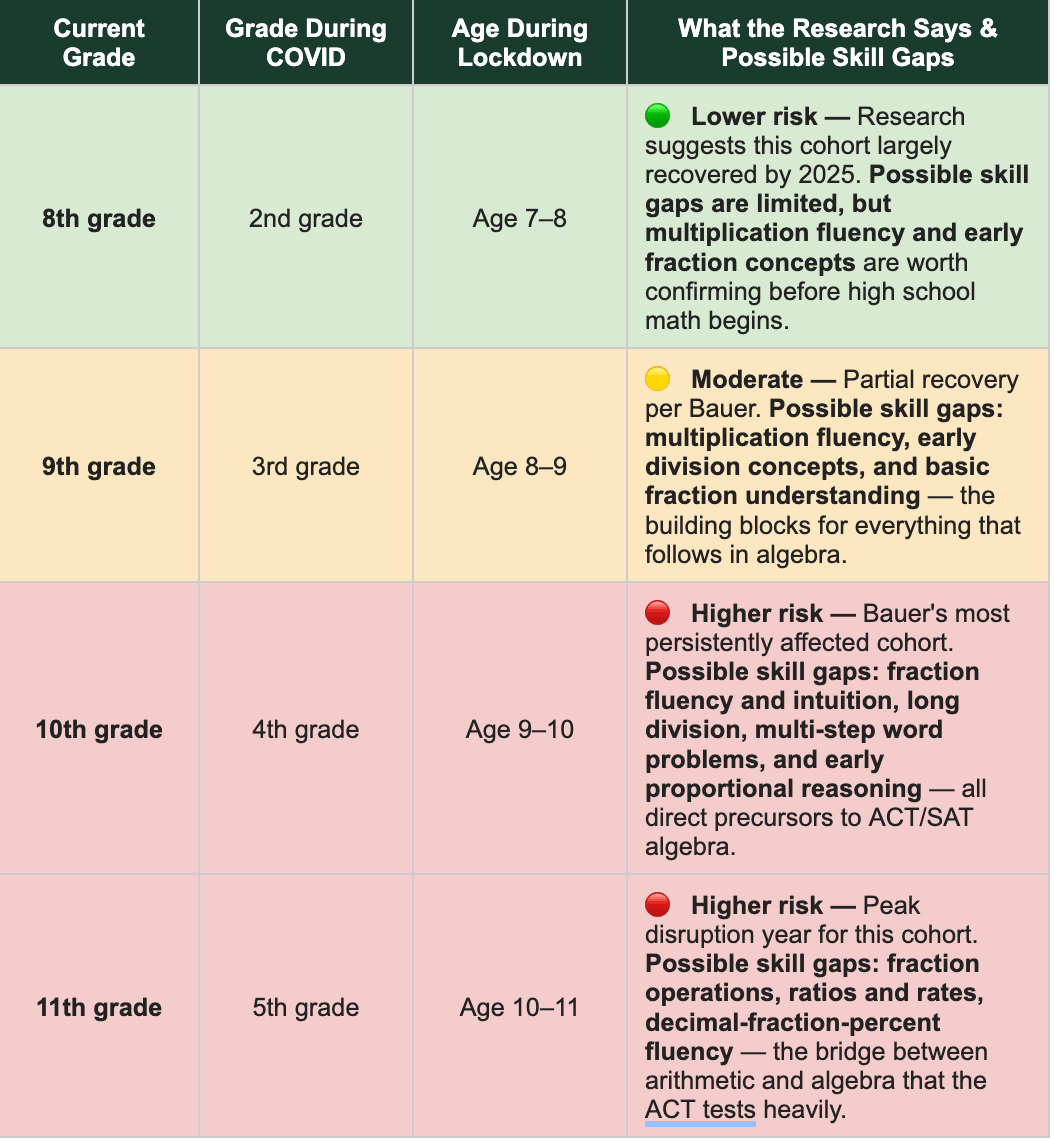
Risk levels based on Bauer & Powell, Brookings / Hamilton Project, December 2025.
One important caveat: the Bauer study tracked students through 8th grade. We don’t yet have data showing how these cohorts are performing in high school specifically. What we do have is what Vickie and I observe directly — and it aligns closely with what the study would predict.
MaTh Course Trajectory + ACT/SAT prep
What Specifically Might Be Missing
For parents who want to know what to look for, here are the skills that teens who were in 4th and 5th-grade durinck COVID lockdown may not fully own — and how each one shows up as a problem on the ACT or SAT three or four years later.
Fraction fluency — not just procedure, but intuition
A student can learn to add fractions by following steps without understanding what a fraction actually represents. On the ACT, fractions appear everywhere — embedded in algebra problems, rate problems, and data interpretation. A student who is procedurally competent but intuitively shaky slows down, second-guesses, and makes errors under time pressure.
Multi-step word problems
The ability to read a problem, identify what’s being asked, select the right operations, and execute them in sequence is a 4th and 5th grade skill that the ACT tests relentlessly. Students who missed this developmental window often know the math but can’t parse what the problem is asking.
Proportional reasoning — ratios, rates, and scaling
This is introduced in 5th and 6th grade and is the bridge between arithmetic and algebra. It underlies a significant portion of both the ACT and SAT math sections. Students who are shaky here often don’t know it, because high school math courses rarely test it in isolation.
Decimal, fraction, and percent relationships
The ability to move fluidly between these three representations — to know instantly that 3/4 is 0.75 is 75% — is the kind of automaticity that frees up working memory for harder problems. Students who have to reconstruct this each time lose time and make errors.
Why High School Math Alone Doesn’t Fix This
This is the part that I think surprises parents most.
High school math is not designed to go backwards. Algebra 1 assumes arithmetic is solid. Geometry assumes Algebra 1 is solid. Algebra 2 assumes both. At no point does the curriculum stop and say: let’s make sure everyone actually owns fractions before we continue.
So a student with a genuine gap in 4th-grade foundations can earn B’s and A’s all the way through Algebra 2, because the tests in those courses reward the procedures they were taught in those courses. The gap travels with them, invisible, until “something” asks them to solve a clean foundational question without scaffolding.
The ACT and SAT are that “something.” So is college math. University professors — including those at UC San Diego — have begun formally documenting that admitted students increasingly lack middle-school-level math skills, even students with strong high school transcripts. The Fordham Institute noted the same pattern: the gap between GPA and actual math competency is now wide enough that admissions offices at selective schools have begun weighting test scores more heavily than GPA in predicting college math success. [Since first writing this post, the University of California system announced it is reverting back to Test Required.}
This is why Vickie and I no longer advise families to wait until the spring of junior year to start thinking about test prep math. By then, you’re trying to close a four-year gap in six months. It can be done, but it’s harder, more stressful, and less complete than it needs to be.
What to Do — and When
The good news is that none of this is permanent. These are learnable skills. The gaps are real, but they are not large — they are specific, and specific gaps respond well to targeted work. The window that matters is now: freshman and sophomore year, before formal test prep begins, while there’s still time to fix up and build the foundation properly.
Get a diagnostic, not a guess. The single most useful thing you can do right now is find out specifically where your student stands on foundational skills — not just on the high school curriculum. Vickie offers diagnostic assessments designed exactly for this: to locate gaps, not just measure the output. An hour of diagnostic work is worth months of unfocused prep.
Don’t wait for a mediocre or bad practice ACT/SAT score. The practice test is a useful signal, but it comes late in the process. By the time a student sits down for an ACT or SAT diagnostic, and scores lower than expected, the timeline to fix it has compressed considerably. A diagnostic in 9th or 10th grade gives you time to actually address what you find and build/rebuild foundational skills.
Understand that foundational tutoring and test prep are different things. If your student has a genuine foundational gap, ACT/SAT test prep will not fix it. Test prep teaches strategies for a specific test. It assumes the underlying math is there. Foundational work builds the underlying math. Both are valuable, but they are not interchangeable — and doing them in the wrong order wastes time and money.
This is especially true for 9th and 10th graders right now. If your child is a current sophomore — the cohort that was in 4th grade during COVID, the group Bauer and Powell identify as the most persistently affected — this is the year to look. Not in a panic. Just with clear eyes.
Not sure where your student stands?
If any of this resonates — or if you’ve been quietly wondering why the math scores don’t quite match the transcript — reach out. A short conversation is usually enough to figure out whether there’s something worth looking at, and what the right next step is.
➡ Book a free consultation — no commitment, just a real conversation about your student.
➡ Read the companion post on reading and writing — a different story, but one every family with a high schooler should know. This is an older post, and is mostly about boys lagging girls in language arts. But now it applies increasingly to all teens in the post-COVID Tik Tok and AI age.