
How Admissions Officers Read Applications

By Valerie Erde
Many students and families don’t think about how admissions officers actually evaluate applications until senior year—when most of the important decisions have already been made. Understanding this process earlier is a bit like reverse-engineering: once you know what colleges hope to see at the finish line, you can make smarter choices about courses, testing, activities, and priorities throughout high school. First, a snapshot.
Most applications go through multiple rounds of review:
Initial Read: A single admissions officer (or two) conducts the first read, assigning ratings for academics, extracurriculars, and personal qualities. They may also flag the application for further consideration or specific programs.
Committee Review: In selective colleges, applications are presented to an admissions committee. This group debates borderline cases, weighs institutional priorities (e.g., diversity, geographic representation), and makes final decisions.
Institutional Needs: Sometimes, decisions are influenced by broader goals, such as filling spots in a particular major, supporting athletic teams, or balancing the class demographics.
Holistic Review Criteria
1. Academics: The Foundation of the Application
First and foremost, colleges are educational institutions, so your high school course rigor and academic performance are their top priorities. One admissions officer summed it up his thinking this way: “Can you do the work? Are you prepared for the curriculum we offer?”
Many families focus primarily on GPA, but GPA alone doesn’t tell the full academic story. Admissions officers don’t evaluate a single number — they evaluate your transcript in context: the difficulty of your courses, what was available at your school, how you challenged yourself, and how your performance evolved over time.
Academic Rating Systems: Many admissions offices assign an academic rating, typically on a scale (e.g., 1 to 5 or 1 to 9). A “1” might indicate near-perfect academics, including top grades in the most rigorous courses, and strong test scores. These ratings are often used during committee discussions to summarize an applicant’s academic profile quickly.
Here’s how they approach this critical element.
Course Rigor Admissions officers look at the difficulty of the courses you’ve taken relative to what’s available at your school. Did you challenge yourself with AP, IB, or honors courses? A rigorous curriculum often signals intellectual curiosity and work ethic. And you should not dial down your rigor senior year.
Course Selection: Did you satisfy their institution’s academic requirements? Did you go beyond in your interest areas? (Always check an institution’s admissions website for minimum high school requirements.)
GPA: Your GPA is considered in the context of your school’s grading policies. Admissions officers also assess trends—did you improve over time or struggle in specific subjects? For example, if you are applying to college as a STEM or business major, it will be important that you have grades in math and/or science courses.
GPA Note: An “A” average at a less rigorous high school is not viewed in the same way by admissions offices as an “A” average at a more rigorous one.
Standardized Test Scores (AP, IB, ACT/SAT): Although many colleges remain test-optional, some have reinstated testing requirements, and others still prefer scores when available. Standardized tests provide a common benchmark that helps admissions officers evaluate and compare students from different schools, particularly in an era of grade inflation.

A University of Michigan student reads her admissions file
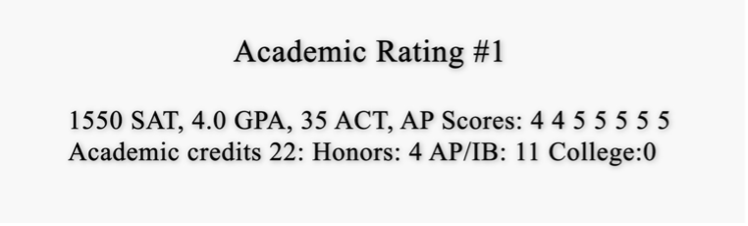
University of Michigan academic rating scale
2. Extracurricular Activities: Showcasing Your Interests and Impact
Extracurricular activities are a critical part of demonstrating who you are outside the classroom, but dmissions officers are not simply counting your activities — they are looking for evidence of your commitment, initiative, and meaningful engagement over time. They will often assign an extracurricular rating based on your level of engagement, leadership, and achievement and typically evaluate your activities in terms of…
Depth vs. Breadth: Depth (dedicating significant time and effort to a few activities) often carries more weight than breadth (participating in many activities at a superficial level). Admissions officers look for sustained involvement and leadership roles.
Impact: Did you make a meaningful contribution? For example, founding a club, leading a team to a championship, or starting a community initiative shows initiative and commitment.
Alignment with your stated goals: Your activities can underscore your academic or career interests. If you’re thinking of becoming a vet, you might volunteer at an animal shelter. If you want to major in CS, you’ll want to be in a coding club or, perhaps, design your own apps.
Uniqueness: Uncommon or distinctive activities can help you stand out, such as competing in an obscure sport or mastering a niche art form. Lots of kids play soccer and violin; not many kids curl or play the organ. (I once worked with a student who raised rabbits – pretty cool!)
Tie in to the college's institutional needs: Extracurriculars can also tie into a college’s institutional priorities. For instance:
Strong musicians may contribute to a university’s orchestral, band or choral ensembles
A student who creates a girls’ math team could support initiatives to increase female participation in STEM.
Recruited athletes may help strengthen varsity programs
Activities Tip: : Being a Jack/Jill of all trades master of none will not serve you well in college admissions.
3. Recommendation Letters: ContextualizE the ApPlicant and Personal Qualities
Recommendation letters offer insight into your character, work ethic, and potential beyond the numbers. Weak or generic letters won’t help you much and/or could raise questions about why a teacher didn’t have more to say about you.
Admissions officers look for:
Specific Examples: Strong letters include anecdotes and specific examples of a your achievements, leadership, growth, or character. For instance, a teacher might describe how you led a group project or came for help and persevered through a tough class.
Unique Character/Values Insights: Admissions officers value letters that reveal qualities not evident in other parts of the application, such as your kindness, curiosity, or ability to inspire peers. Will you be a good roommate, teammate, classmate
Source Matters: Teacher recommendations carry weight because they come from individuals who’ve observed you in an academic setting. Counselor letters provide a broader perspective, highlighting your contributions to the school community or personal challenges you’ve overcome.
Here’s an example of one college’s recommendation letter rubric:

Recommendations Tip: work on developing strong relationships with your school counselor and select teachers.
4. College Essays & Supplements: The Heart of the Application – and writing skills
Essays are where admissions officers hear directly from the student, making this section one of the most personal and impactful parts of the application. However, essays are rarely the tipping point.
Authenticity: Admissions officers are experts at spotting insincere or overly polished essays. They look for a genuine voice and a clear sense of who you are.
Narrative and Reflection: The most memorable essays tell a story—whether it’s about a personal growth, a strong interest, or a unique insight —and then reflect on its significance. Admissions officers want to know how you think and what values drive you. Here are real comments about an essay “What a lovely kid -- I want a person like this” and “The student showed a humanity that felt powerful. Eyes welled.”
Connection to the School: Some essays, especially supplemental ones, assess your fit for a specific college. For instance, a “Why Us?” essay should demonstrate your understanding of the college’s offerings and how they align with your goals.

Yale srudent reads the comments about her essays.
College Essay Tip: Essays should reflect your personality, values, and interests. Focus on the “who” not the “what.”
Read some of our former students’ essays on our blog.
5. Institutional Priorities/Mission.
This is usually the part of admissions that students and parents understand the least. Colleges make some decisions based on their internal goals—like balancing majors or meeting strategic targets—which can really shape who gets in, even if it’s not obvious from the outside. Here are specific examples from various institutions:
a. Geographic, racial, income diversity Initiatives:
University of Georgia (UGA): UGA emphasizes enrolling students from diverse backgrounds, including geographic diversity. In 2023, 15% of admitted students were from out-of-state, with the top three states being California, Florida, and Maryland.
University of Notre Dame: Notre Dame has expanded its need-blind admissions policy to include international students, beginning with the Class of 2029. This change reflects the university's commitment to socioeconomic diversity and accessibility.
b. Academic Program Strengthening:
Rutgers University: As part of its strategic plan, Rutgers aims to enhance its academic standing in key departments where it lags peer institutions.
Yale University: often trails some of its peers in math and engineering. That means, if you are particularly strong in those areas, you may have an edge in getting into Yale vs. MIT or Harvard.
How one student filled in an academic need:
“I did a bunch of Data Science projects, tppk AP State. I applied as a Data Science major and that’s one of the areas Yale has been trying to push hard, so I was a good fit for that.”
c. Athletic Recruitment: Stanford actively recruits student-athletes to maintain competitive sports programs. Athletic talent is a significant factor in admissions, aligning with the university's commitment to excellence in athletics. [link to athletics blog post]
d. Legacy Admissions: This practice supports alumni relations and encourages donations, though it has been subject to debate regarding
6. Holistic Review: Seeing the Whole Picture
Many colleges use a holistic admissions process, meaning they consider all aspects of an application rather than relying solely on academic metrics. This approach ensures students are evaluated as individuals, not just as data points.
Admissions officers look for evidence of:
Passions and Interests: Through extracurricular activities, essays, and awards, officers gauge what excites you and how you’ve pursued those interests.
Resilience: Overcoming challenges or setbacks can show strength of character and determination.
Contribution to Campus: Colleges seek students who will enrich their communities. Leadership roles, volunteer work, and unique talents can signal this potential.
The Final Takeaway
Every part of your application matters. Your grades in courses show you can do the work. Your activities show what drives you. Your letters reveal how others see you. And your essays let your voice shine through. Together, they show who you are—and how you’ll show up on campus. Colleges aren’t looking for perfect. They’re looking for real people ready to contribute, grow, and make an impact.